
The Need for Adaptive Fitness Trainers Part 2: The Disability Population Exists. The Fitness Infrastructure Doesn’t.
In the article The Need For Adaptive Fitness Trainers, we explored why the fitness industry urgently needs more adaptive fitness trainers.
People with disabilities (PwD) are one of the most underserved populations in health and fitness, despite representing a significant portion of society. We also explored how many trainers genuinely want to help but simply were never educated on how to confidently and safely train people with disabilities.
But there is another question we need to ask:
If nearly 1 in 4 people have a disability1…
👉 Why don’t gym communities reflect that proportion?
You don’t see 25% of the gym membership with a disability!
Although not all disabilities are visually apparent, there should still be an equivalent proportion of your gym members with disabilities. But, this just isn’t happening. And, many gyms don’t have any PwD at all! What’s the issue(s)???
The Disability Population Exists. The Fitness Infrastructure Doesn’t.
People with disabilities are not absent from society. They are absent from fitness programs. That distinction matters.
When many gym owners or coaches think about disability access, they often think about physical accessibility alone: ramps, elevators, wider doorways, or handicap parking spaces. While those things absolutely matter, accessibility in fitness goes far beyond architecture.
A gym can technically meet ADA requirements and still feel completely inaccessible to a person with a disability.
Why?
True inclusion is heavily influenced by communication skills, accessibility signaling, culture, social interactions, and awareness. Most fitness facilities are not intentionally designed to exclude people with disabilities. In fact, many gym owners genuinely believe they are inclusive. But inclusion without preparation or action to offset exclusionary biases often creates environments where people with disabilities still feel unsupported, unsafe, or unwelcome.
Sometimes the barriers are physical:
-
Equipment layouts that cannot accommodate mobility devices (like wheelchairs),
-
Front desks and check-in areas don’t have accessible desk heights, or the self-check-in technology is difficult to use (for many reasons)
-
The way equipment is stored (like bands hanging above dumbbell racks, making it difficult to reach)
-
Fitness machines that are inaccessible due to equipment spacing
Other times, the barriers are social or a lack of knowledge about disability training:
-
People with disabilities may not see themselves reflected in gym marketing or in the membership population (a signal that they may not belong there)
-
A trainer may want to help but have no idea how to program for the needs of their ability or adapt a group workout (safely and effectively)
-
Staff members may become uncomfortable or overly cautious because they fear saying the wrong thing or causing harm
-
Coaches may panic when traditional exercises need to be modified from more than a simple scaling option
👉 And people with disabilities notice this immediately.
Many have experienced going into a gym only to feel invisible, awkward, or treated like a liability instead of a member. Some report being ignored by staff entirely because nobody knows how to approach them. Others are handed workouts that clearly were never designed with them in mind, with no meaningful attempt at adaptation. Even when the intentions are good, the experience can still communicate: “This program and community were not built with you in mind.”
After enough negative experiences, many people simply stop trying. Not because they do not want to improve their health. Not because they lack motivation. But because constantly fighting to access fitness becomes exhausting.
This is one of the biggest misconceptions in the industry: people with disabilities are often described as “hard to reach,” when in reality, the fitness industry has simply failed to build systems designed to reach them.
1️⃣ Step 1 for gyms and trainers is awareness that they may not be as accessible as they think. Time to review your physical and digital spaces as well as your program offerings.
2️⃣ Then, step 2 is to take action!
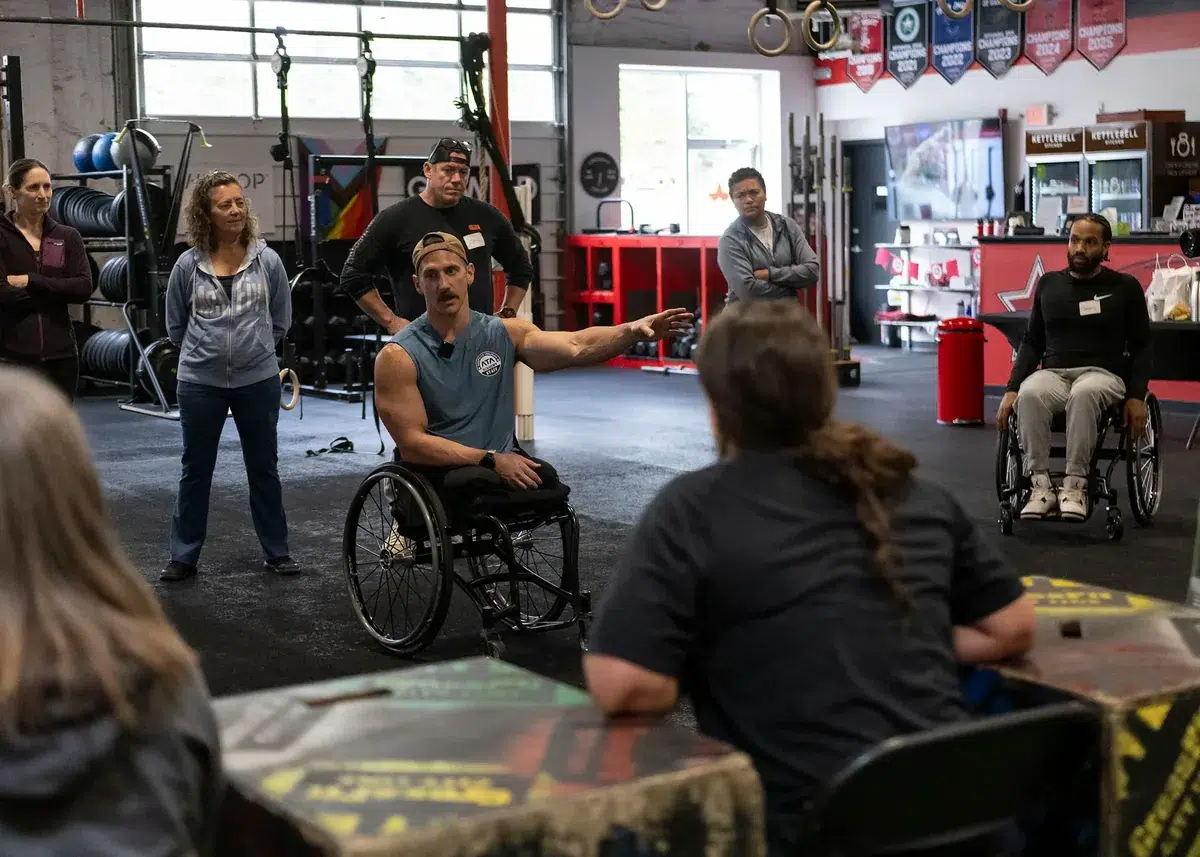
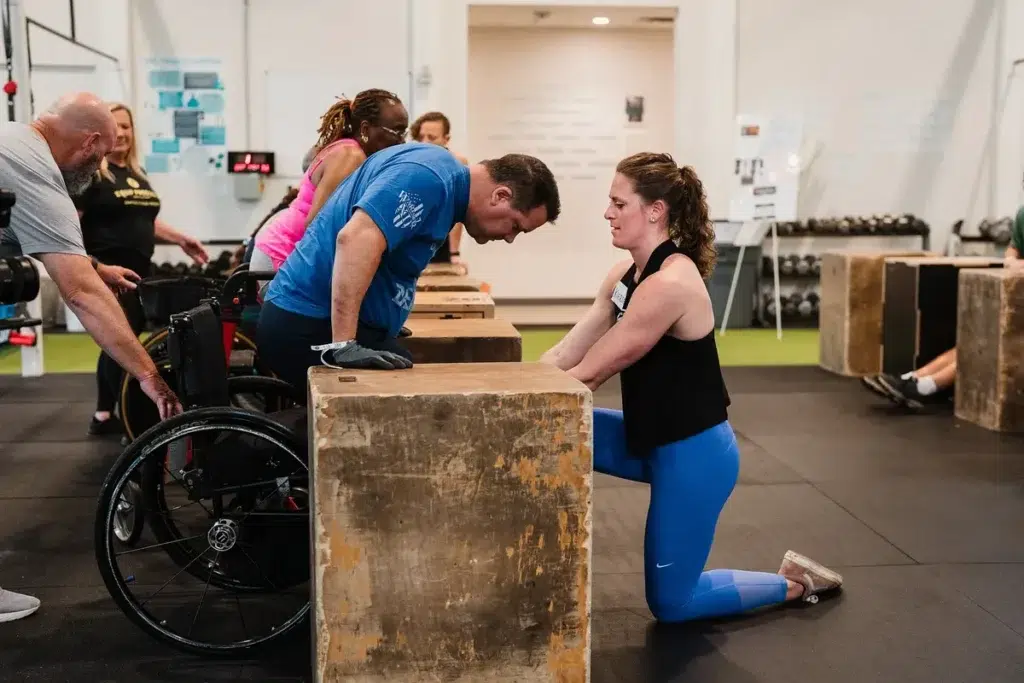
ATA Seminar Staff Mike Egan coaches trainers through a dip progression.
So What Do We Do About It?
The good news is that solving this problem does not require every gym to completely rebuild itself or purchase massive amounts of expensive adaptive equipment.
What the fitness industry needs most right now is not perfection. It needs organizations and trainers willing to start. That’s it. Simply start offering your services to people with disabilities. Sounds easy, right? Well…it is 🙌
ATA recommends starting training with one person. Be humble and admit your inexperience and openness to learn with your trainee. Then, when you know better, make better choices for them and grow your program and adaptive community. Inevitably, people in the disability community will recommend your services after a great experience. Your word-of-mouth referrals will skyrocket!
But if you want the cheat code and want to ramp up your knowledge, earn your specialized adaptive education.
Adaptive Training Academy has now graduated more than 6,000 trainers through the Adaptive & Inclusive Trainer (AIT) Course, with certified coaches located around the world and listed on ATA’s searchable trainer directory and map.
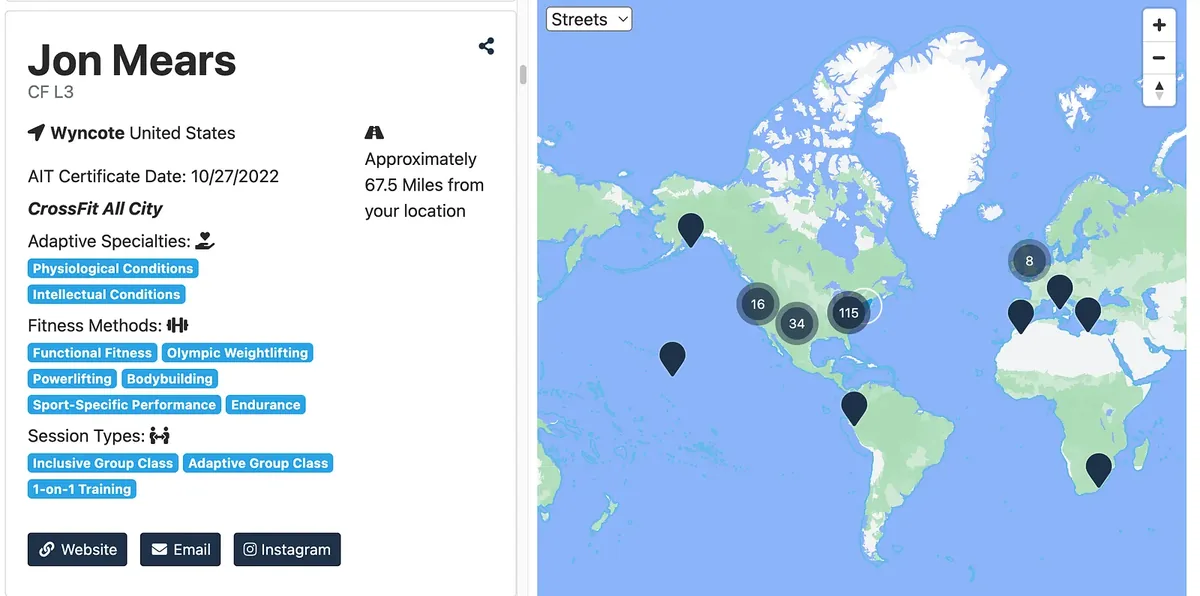
ATA Trainer Directory and Map. Ref: https://www.ata.fit/trainer-map/
Having certified trainers is meaningful progress. But it also highlights the size of the problem. If nearly 1 in 4 people live with a disability (~87,000,000 in the USA), the current number of adaptive fitness trainers and programs is still nowhere near enough to provide the baseline level of access that should already exist within the fitness industry.
🚨 That’s 1 certified trainer for every ~58,000 people with a disability
More trainers are needed. More programs are needed. And more gyms need to stop waiting until they feel “fully ready” before getting started. The reality is that most gyms are far closer to serving people with disabilities than they realize.
🔑 Takeaways:
-
Get started now! Don’t wait. Start training one person or a small group and grow naturally from there.
-
Ramp up your knowledge with specialized trainer education. This also signals to the disability community that you’re serious about training them becuase you have the credentials to prove it!
But Can I Make Money Serving PwD?
In Part 3 of The Need For Adaptive Fitness Trainers, we’ll explore the business case behind adaptive fitness:
-
Why gyms are missing out on a significant revenue stream
-
Why adaptive fitness may represent one of the largest untapped markets in the industry
-
Why motivated trainers should consider opening facilities specifically designed to serve people with disabilities
👉 Inclusion is not just the right thing to do; it may also be one of the biggest business opportunities in modern fitness.
Notes
-
Centers for Disease Control and Prevention (CDC). Disability Impacts All of Us. U.S. Department of Health & Human Services. https://www.cdc.gov/disability-and-health/articles-documents/disability-impacts-all.html